



Destiny Magazine's Power of 40 2016 editorial feature profiles South Africa's 40 most powerful and influential young women across business, sport, arts, science, and public service. Portrait photography by Michelle Wastie.
LAURA WINDVOGEL (29) Multi-disciplinary artist. From: Johannesburg, Gauteng
Known more widely by her pseudonym Lady Skollie, Windvogel works vividly in watercolours, ink and crayon and also creates podcasts and poetry. Her most recent exhibition, Hottentot Skollie, at Cape Town’s WorldArt Gallery, delved into the history of Sarah Baartman and explored the objectification and consumption of the female form. “It delved into the concept of the black female body being hyper-sexualised from even before Sarah’s time. In many ways, it’s crazy how we’re still in those cages. So the exhibition included some writings on Instagram being a new cage, for instance.
“As coloured women, many of us don’t know the story of Sarah. I feel coloured women are among the angriest I encounter. They’re also most in need of understanding and positive affirmations within their culture. Having a big bum and being seen as a ‘boesman’ is negative, while assimilating ourselves to whiteness is seen as better. I’m going to do much more work about it. It’s very important for us to know our history,” she explains.
Having recently relocated to Johannesburg, Windvogel’s main themes remain sex, greed, lust and body positivity, often framed within a context that looks critically at sexual abuse. These themes run through her now famous drawings and paintings of papayas and bananas, used riotously to illustrate genitalia. South African contemporary artist Athi-Patra Ruga is one of her mentors. “He inspires me so much because all he ever does is create his own world. That’s what I try to do. Like drawing live people having an orgy, which ends up being quite funny because it’s done in my humorous, childlike, garish style. I like dealing with serious topics in a way that’s fun to look at and aesthetically pleasing. I also have a hectic imagination, but am cursed with conscience. So I can paint these scenes, but don’t always want to act them out. Morally, I can be quite beige. I’m a serial monogamist, for example,” she admits.
She says 2017 will be her year for business consolidation. The Hottentot Skollie exhibition placed her work in a new price bracket upwards of R28 000 apiece. “I’d like to package my work into one offering and sell it together. I don’t want to do piecemeal things any more. It’s time for nine million people to see my shit!” she says. — SA
PINKY ZUNGU (33) Deputy Harbour Master – Nautical: Port of Durban. From: KwaZulu-Natal (KZN)
In 2011, Zungu became one of the first three women in Africa to obtain a Marine Pilot’s Open Licence and earlier this year, the Transnet National Ports Authority appointed her the first black female Deputy Harbour Master. “I’ve always wanted to be out of the ordinary and that’s propelled me forward. I hope to take the port of Durban to a new level of professionalism and ensure that it’s the safest and most efficient port in the world,” she says. Her ambition and tenacity have made her one of the women who are changing the face of the industry. “I’ve faced various challenges, having to prove myself to my male counterparts, but I always listen to my inner voice and encourage and push myself until I achieve my goals. Failure isn’t an option,” says Zungu. Looking forward, she’d like to study and rise further up the maritime corporate ladder. “It’s important to stay true to who you are and not be afraid to break boundaries,” she says.
POWER PRINCIPLE: “I’m here on this earth for a reason.” — NO
ELLEN CHILEMBA (22) Founder of Tiwale. From: Malawi
Change-agent Chilemba founded Tiwale when she was a teenager. The social enterprise offers leadership workshops, micro-loans, vocational skills training and school grants to women in Malawi. “I was exhausted by the daily headlines of monetary scandals among the historically corrupt leadership in our country,” she says. “I knew I had to take action to empower women in my community.”
Her venture has trained over 150 women as entrepreneurs by teaching them how to tie-dye fabric, sew and make tote bags. The funds raised from sales have enabled her to buy land to build a women’s centre. “The goal is to use this space to provide secondary school classes, a community library and a garden, and to host workshops on health education,” she says. Chilemba’s studying economics at Mount Holyoke College and in 2015 she was one of the winners at the Future Forward: Youth Innovations for Employment in Africa challenge. She attributes her success to seizing opportunities that present themselves and constantly networking. “It’s very important to support other women. Nobody else has to lose in order for you to win. We can all accomplish much more together,” she says. — NO
MATSI MODISE (32) Founder of SIMODISA. From: Johannesburg
SIMODISA is an industry association that collaborates with policy-makers to enhance the success rate of entrepreneurs. Modise’s also the South African Chapter Head of Africa 2.0, a civil society organisation comprising 300 emerging leaders who are committed to finding and implementing sustainable solutions towards development on the continent.
“SIMODISA aims to be the golden thread that connects SA’s dynamic entrepreneurship ecosystem by shifting the needle of progressive policy and regulation governing small businesses and entrepreneurship in SA,” she says. As the Founding Curator of the World Economic Forum Soweto Global Shapers Hub, this year she was selected as one of the top 50 Global Shapers and sat on a panel with the Global CEO of Coca-Cola, Muhtar Kent, co-founder of Airbnb, Nathan Blecharczyk and WILL.I.AM of the Black Eyed Peas. “I’ve learnt to create my own opportunities, coupled with faith and gratitude for God-given blessings. You need to charter your own success,” says Modise. Looking ahead, she envisages growing SIMODISA into a world-class institution. What advice can she offer aspiring entrepreneurs? “Always begin with the end in mind. Nothing happens by chance. Be very intentional about where and to which level you want to take your success.” — NO
RACHEL SEABELA (32) General Manager: City Power. From: Johannesburg
At the age of 30, Seabela became the youngest General Manager ever to work at City Power. The IT graduate was tasked with starting her own department from scratch. The daughter of a taxi owner, Seabela first learnt her work ethic from watching her father run his business in Hammanskraal, Gauteng. “He taught me the value of having a life beyond work,” she says.
The new mother is currently a core convenor for the International Electrotechnical Commission, a body that influences the global policies and standards affecting how cities are built. “My team submitted a proposal to use Johannesburg as a global tester for smart cities. This means that if Japan has a new device to test, they bring it here,” she explains. The proposal is just one of the steps she’s taken to improve life in Jo’burg. “It’s put the city on a globally competitive level because new technology is being brought here first,” she says.
She also sits on the Executive Committee of the Association of Municipal Electricity Utilities’ Women in Electricity initiative. Seabela believes that the secret of success is running one’s own race.
POWER PRINCIPLE: “If you want something done, do it yourself. Even if you get help, it’s still your responsibility.” — SM
JENA MUKINA (33) Founder of Little Ashford Preschool. From: Johannesburg
Mukina and her business partner, Marli Hoffman, are revolutionising the preschool sector. Unable to find a suitable daycare centre for her daughter in 2009, she started Little Ashford. “I’ve always been passionate about education, so I saw it as an opportunity to start a small business,” she says. “I strive to create a child-centric environment that takes a holistic approach to raising youngsters.” Research and innovation are the key factors that set it apart, as it’s one of the first preschools in Africa to introduce iPads into the classroom. “Technology is part of preparing children for their future. If they’re engaged in experiences, they learn easily. Parents are made to understand that iPads don’t replace anything – rather, they’re additions to everything else that exists in a traditional preschool environment,” says Mukina. The company’s grown to 10 schools, over 600 children and 155 staff members, and there are plans to open more. “We’re striving to be the best preschools in the country by being dynamic, cutting-edge and at the forefront of research and development on children pedagogies. We want as many families as possible to have access to the best,” she says.
POWER PRINCIPLE: “Dreams aren’t enough; you have to act. Stop talking – just do it.” — NO
REBECCA FRANKS (26) Senior Android developer and Google developer expert. From: Johannesburg
Franks is crashing through glass ceilings as the first female Google developer expert in Africa. In this role, she works with businesses to develop new features for apps such as DStv Now and Agile Scrum Poker.
“Being the first female in Africa is significant because it means more women will get involved in the industry and start thinking about working in technology. I see it as a positive way in which other women can draw inspiration,” she says. After graduating as a software engineer, she worked in different areas of web and mobile development before specialising in Android. She began making apps, started a blog and became more active in the development community. She was then head-hunted by Google.
She also volunteered to develop an Android app for Book Dash, an NPO that strives to improve literacy by offering free storybooks in SA’s 11 official languages. “I want the app to inspire young kids to read. It’s incredibly satisfying to create something no one else has ever created before, while providing solutions to societal issues,” says Franks. — NO
JEANINE ENGELBRECHT (36) Principal Researcher: Synthetic Aperture Radar, CSIR Meraka Institute. From: Stellenbosch, Western Cape
At the helm of cutting-edge research which aims to solve societal challenges, Engelbrecht’s currently working on Azimuth, a system that uses satellite images to measure small-scale movements of the earth’s surface. “The goal of Azimuth is to detect unstable areas and provide early warnings to minimise loss of life and damage to infrastructure. In this way, our small-scale measurements can have a massive impact,” she says.
Not only is Engelbrecht a bright light in the research sector, but in 2015, she participated in the Venture Leaders Programme, which culminated in her competing against 18 start-ups at PitchFest at Google in Switzerland. “It was a phenomenal experience, as we got to meet successful start-ups and learn about their entrepreneurial journeys,” she says. “Five of the six start-ups that made it through to the final round were South African, which highlights the impact the programme has on developing local entrepreneurs and preparing them to be competitive in the global arena.”
Her sights are set on spearheading the commercialisation of Azimuth to address health and safety concerns caused by geological hazards and mining activities. Her most important business lesson? “Be agile. Things don’t always go as planned, but flexibility to adapt to changing conditions can lead to interesting opportunities.”
POWER PRINCIPLE: “Work harder than the next person. That’s what will separate you from the rest.” — NO
NOBESUTHU NDLOVU (35) Co-founder of Burgundy Fly. From: Soweto, Gauteng
Ndlovu worked her way up from being an assistant hawker to co-owning five branches of clothing boutique, Burgundy Fly. Today her stores employ 20 young people and house the fashion lines of up to 20 local designers. “My work ethic stems from my days of helping my dad sell chips on Bree Street in the Jo’burg CBD during school holidays,” she says.
The UCT IT graduate remained at her job in the corporate sector for eight years before she felt her business was sturdy enough to stay afloat. “I’m proud of having a black-owned business which sells the creations of mostly black designers while employing young black people. It’s proof that the ecosystem works,” says Ndlovu. She adds that her business has made R16 million in the past eight years and hopes to see Burgundy Fly become a household name in SA, with outlets operating in all the world’s fashion capitals, starting with New York.
POWER PRINCIPLE: “Focus on your own focus. It really works!” — SM
LESEGO NCHUNGA (28) Civil society lawyer, poet, musician, actress and playwright. From: Kavimba, Botswana
When Nchunga was made Partner at law firm Dow & Associates at the age of 26, she became the youngest female partner in Botswana and remained so for a year. And she’s managed to balance her legal career with an equally exciting calling as a performing artist. “I was born an artist,” she muses. “I fell in love with writing poetry in Third Grade English classes and I haven’t stopped since.” As a poet, musician and actress, she’s performed in Botswana, SA, Zimbabwe, Angola, Namibia and the USA, and co-wrote several of the plays in which she’s performed.
She’s also retained her compassion and social conscience. “I like to refer to myself as a civil society lawyer because my interests lie in human rights litigation and advocacy. I take pleasure in serving others,” she says. She’s done significant work in conservation, domestic violence, LGBT rights and legal recognition of tribal minorities. Lesego’s now pursuing her Master’s degree in development practice at the University of Botswana and working on transgender and intersexuality litigation, both areas which Botswanan law fails to address. — KN
KIRSTY BISSET (29) Founder of Stir, Dream Republic and Braai Free. From: Johannesburg
Bisset is the ultimate go-getter. In 2012 this serial entrepreneur founded digital agency Stir with the aim of helping brands connect with their consumers in a very personal way. The company now has a number of international clients, including Ultra Liquors, the CEO SleepOut and Accenture. “Given that Stir started in my spare bedroom and is now competing against the biggest agencies in SA, I’m very happy with what we’ve achieved. But my target is always moving,” she says.
She’s also the founder of two ecommerce stores: Braai Free, which specialises in top quality meat hampers and Dream Republic, which stocks an exclusive range of Serta bed and base sets. “Ecommerce gives me butterflies. We’re at a very exciting tipping point in SA, where online sales are escalating rapidly. Both these businesses are up against some of the biggest retailers in the country, but we’re accomplishing what we set out to do – reach more people with a personalised offering at a more affordable price,” says Bisset. All three businesses will be diversifying their product offerings by the end of the year and she has another company in the works. “In business I’ve faced constant rejection, but I never take ‘no’ personally. It’s important to have perseverance, a sense of humour and a strong support system,” she says.
POWER PRINCIPLE: “Feel uncomfortable in comfort zones. If you’re comfortable, you’ve settled and can’t grow.” — NO
CELESTE ARENDSE (31) Fashion entrepreneur. From: Cape Town
Arendse’s Selfi range of quirky, gorgeous tailored dresses and separates has a loyal following of stylistas attracted by her bespoke prints, modern, androgynous cuts and striking palettes. The brand’s already seven years old and is available at www.selfi.co.za, as well as at a range of boutiques in Cape Town and Jo’burg. Arendse says the fashion business is in her genes, as her mother runs a successful Cape Town clothing factory.
She’s just opened a new studio space and believes her brand’s in a new phase of growth. “I think we may be close to reaching saturation point in the local market, so I really want to scale the business. I’m interested in driving the brand in markets that really understand us,” she says. These efforts include a new unisex line, Selfi bags and shoes, as well as a travelling showroom concept which she trialled in London in October. A collaboration with the British Council, the showroom saw Arendse put on a mini exhibition alongside a few other selected South African designers in an intimate setting for UK-based clothing buyers. “I’m really excited about expanding my product range and, in particular, creating unisex pieces that open us up organically to dandy clients who appreciate art and are confident in their sexuality,” she says. — SA
THULI MOLA (30) Founder of Style Alert. From: Soweto
“I owe everything to social media. My business would never have succeeded without it,” says Mola. After being retrenched from her job at an events company, she turned her hobby of blogging into a commercial opportunity. Her brand, Style Alert, was born as a pop up store selling secondhand clothes. “I’d post my outfits on Facebook and people would offer to buy them for double the price,” she recalls. Although Mola didn’t initially produce her own garments, she had a flair for styling. Her business grew from trading in her backyard in Soweto to operating her own trendy boutique in Johannesburg, with seven employees. “I’ve yet to reach my proudest career moment. So far, my greatest achievement is my son. He notices when I’ve changed my hairstyle!” she laughs.
Style Alert boasts over 60 000 followers on Facebook. Due to the growth in demand for the garments, Mola recently moved into a bigger location. Last year the fashion entrepreneur also founded the Style Alert Master Class, an initiative that teaches women how to dress well for their different body types. The Master Class also empowers upcoming fashion entrepreneurs with networking opportunities and business advice. Mola’s target market is predominantly women between the LSM 6-10 who are style, price and value conscious. — SM
ROXI WARDMAN (28) Chef and restaurateur. From: Durban, KZN
This supremely talented domestic goddess made a name for herself by winning Season 3 of M-Net’s cooking show, MasterChef SA. While she was always passionate about food, she’d never imagined she could turn her culinary skills into a profession before then. Wardman, who moved to Durban as a child, is a former train driver’s assistant and says she entered the competition with her husband’s encouragement.
“I almost chickened out of both the second- and third-season auditions. Luckily, I didn’t – and the experience has really helped me. I used to be painfully shy and talking to strangers would have me breaking out in hives, but that’s totally changed. Winning was a huge confidence boost, as I’d never really believed in my own abilities. It was only when I progressed in the competition that I started believing in myself. I’m a completely different person now,” she says. Entirely self-taught, she nurtured her skills by experimenting in the kitchen and reading widely. “I’ve started up my own café, Spoonful Eatery, with my husband and it’s doing well. I’m finally living my passions and couldn’t be happier,” says Wardman. — CP
ASNATH MAHAPA (36) Pilot and founder of the African College of Aviation. From: Johannesburg
Mahapa’s been breaking barriers in the aviation industry since she became the first female African pilot in SA in 1998. She’s since worked tirelessly to help more females enter this male-dominated sector. “Becoming the first African female to acquire an Airline Transport Pilot’s Licence comes with a lot of responsibility,” she says. “Many young women look up to me. I need to make sure I’m a good role model and always do my best.”
In 2012 she founded the African College of Aviation, which aims to train a new generation of pilots. It’s the first flight training school to be 100% African-owned and also the first to be managed by African women. Mahapa’s also a beneficiary of SAA’s cadet pilot training programme, as well as the recipient of the Department of Labour and the Transport Education Training Authority’s bursary scheme, set aside for previously disadvantaged communities.
“Unfortunately, not much has changed. The number of women in the industry is still almost nil. The college aims to give young women the confidence to pursue their dreams,” she says. How has she achieved her success in such a male-dominated sector? “It took a long time to get here and to be accepted. Even now, I can’t afford to slip up. Only 6% of pilots are female worldwide, so there’s still a lot to be done,” she says.
POWER PRINCIPLE: “JUST DO IT!” — NO
MPHO SEDIBE (30) Founder and Managing Director: Mopsy Strategic Advisors. From: Johannesburg
Sedibe applied for a job as a consultant at South African Breweries, but instead a business opportunity landed in her lap. She’s now the head of a firm which provides black economic empowerment (BEE) advice to large corporates. The chartered accountant spends her days trying to shift perceptions about the initiative. “My aim is to get companies to stop viewing BEE as a grudge regulation, but as an investment for which they’ll get a great return. When I see my work translating into benefits for a client and a beneficiary, I know I’m doing a good job,” she says.
A UCT graduate, she was educated by her mother, who was a domestic worker in Mpumalanga. “Her employers paid for my school fees and deducted the money from her salary,” recalls Sedibe. She obtained six distinctions in matric, which helped her find funding for university. She says her proudest moment was telling her mother that she no longer needed to work.
POWER PRINCIPLE: “Trust the Lord with all your heart and lean not on your own understanding. In all your ways, acknowledge Him and He will make your paths straight.” — Proverbs 3:5-6 — SM
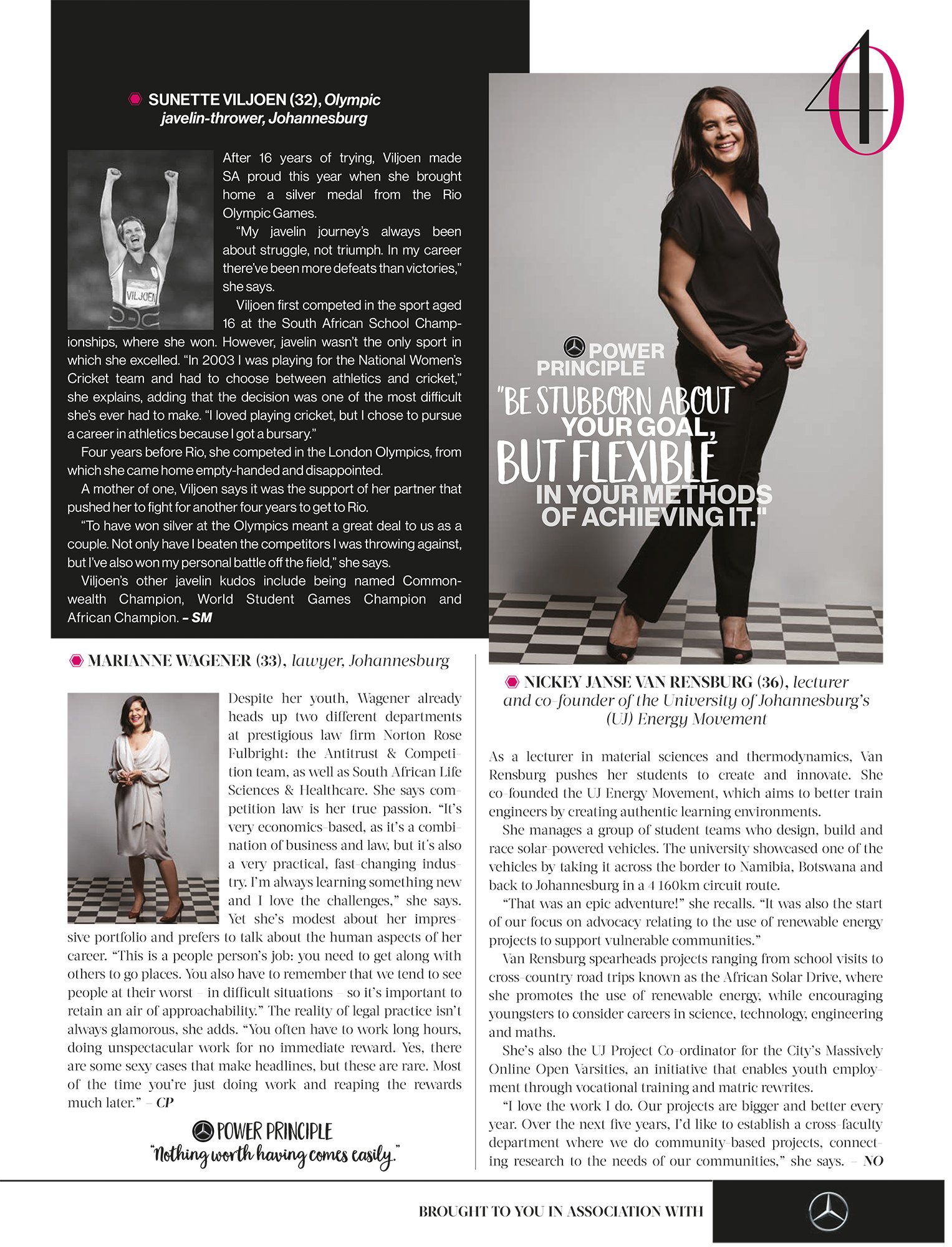
SUNETTE VILJOEN (32) Olympic javelin-thrower. From: Johannesburg
After 16 years of trying, Viljoen made SA proud this year when she brought home a silver medal from the Rio Olympic Games. “My javelin journey’s always been about struggle, not triumph. In my career there’ve been more defeats than victories,” she says. Viljoen first competed in the sport aged 16 at the South African School Championships, where she won. However, javelin wasn’t the only sport in which she excelled. “In 2003 I was playing for the National Women’s Cricket team and had to choose between athletics and cricket,” she explains, adding that the decision was one of the most difficult she’s ever had to make. “I loved playing cricket, but I chose to pursue a career in athletics because I got a bursary.”
Four years before Rio, she competed in the London Olympics, from which she came home empty-handed and disappointed. A mother of one, Viljoen says it was the support of her partner that pushed her to fight for another four years to get to Rio. “To have won silver at the Olympics meant a great deal to us as a couple. Not only have I beaten the competitors I was throwing against, but I’ve also won my personal battle off the field,” she says. Viljoen’s other javelin kudos include being named Commonwealth Champion, World Student Games Champion and African Champion. — SM
MARIANNE WAGENER (33) Lawyer. From: Johannesburg
Despite her youth, Wagener already heads up two different departments at prestigious law firm Norton Rose Fulbright: the Antitrust & Competition team, as well as South African Life Sciences & Healthcare. She says competition law is her true passion. “It’s very economics-based, as it’s a combination of business and law, but it’s also a very practical, fast-changing industry. I’m always learning something new and I love the challenges,” she says.
Yet she’s modest about her impressive portfolio and prefers to talk about the human aspects of her career. “This is a people person’s job; you need to get along with others to go places. You also have to remember that we tend to see people at their worst – in difficult situations – so it’s important to retain an air of approachability.” The reality of legal practice isn’t always glamorous, she adds. “You often have to work long hours, doing unspectacular work for no immediate reward. Yes, there are some sexy cases that make headlines, but these are rare. Most of the time you’re just doing work and reaping the rewards much later.”
POWER PRINCIPLE: “Nothing worth having comes easily.” — CP
NICKEY JANSE VAN RENSBURG (36) Lecturer and co-founder of the University of Johannesburg’s (UJ) Energy Movement. From: Johannesburg
As a lecturer in material sciences and thermodynamics, Van Rensburg pushes her students to create and innovate. She co-founded the UJ Energy Movement, which aims to better train engineers by creating authentic learning environments. She manages a group of student teams who design, build and race solar-powered vehicles. The university showcased one of the vehicles by taking it across the border to Namibia, Botswana and back to Johannesburg in a 4 160km circuit route.
“That was an epic adventure!” she recalls. “It was also the start of our focus on advocacy relating to the use of renewable energy projects to support vulnerable communities.” Van Rensburg spearheads projects ranging from school visits to cross-country road trips known as the African Solar Drive, where she promotes the use of renewable energy, while encouraging youngsters to consider careers in science, technology, engineering and maths. She’s also the UJ Project Co-ordinator for the City’s Massively Online Open Varsities, an initiative that enables youth employment through vocational training and matric rewrites.
“I love the work I do. Our projects are bigger and better every year. Over the next five years, I’d like to establish a cross-faculty department where we do community-based projects, connecting research to the needs of our communities,” she says.
POWER PRINCIPLE: “Be stubborn about your goal, but flexible in your methods of achieving it.” — NO
BONOLO MATABOGE (21) Founder of Afriblossom. From: Johannesburg
At the tender age of 16, Mataboge discovered her calling during a year-long school exchange programme in Minnesota, USA. “I always knew I was going to be in the creative space, but it was in the USA that I decided to become a fashion designer, focusing on plus sizes,” she says. Having been plus-sized herself, Mataboge says she was shocked at how accessible, age-appropriate and trendy plus-sized clothes were overseas. “I suddenly understood what a thin person feels like, knowing that when they walk into a store, they’ll find their size!” she recalls. This prompted her to give fuller-figured women in SA the same options.
Mataboge returned home to complete her matric with six distinctions, which helped her gain entry to a design school. But it was while pursuing fashion at Lisof College in Johannesburg – then aged 19 – that her ambition was shaken by a crippling bone disease. “I couldn’t elevate my swollen feet because I had to work on a sewing machine. Then an infection forced me to drop out of college,” she says. However, Mataboge refused to let her circumstances dictate her future. “I didn’t want to waste the year and I was already working on a fashion show project for college, so I decided to re-focus and organise a fashion show for my family and friends.” Word about the show spread and the idea was eventually pitched to the City of Joburg, as well as other sponsors. “That’s how Afriblossom was born,” she says. She’s yet to undergo surgery to realign her spine, which was affected by the bone disease. “I feel I may have less time than other people, so I need to work harder,” she says.
POWER PRINCIPLE: “In the midst of winter, I found there was within me an invincible summer.” — Albert Camus — SM
CATHERINE LÜCKHOFF (35) Founder of NicheStreem. From: Cape Town
With business savvy and tenacity, Lückhoff’s tuning into the needs of the music industry. Her company, NicheStreem, aims to address the gap in the market for tailored music-streaming services. Liedjie.com is the first stream in the NicheStreem stable. It’s an on-demand streaming service dedicated to Afrikaans music and features over 20,000 tracks and more than 750 playlists for every mood, genre and occasion. “At NicheStreem we aim to prove that music streaming can be profitable, both for the business and the music rights-holders,” says Lückhoff. “Offering all the music in the world is a compelling proposition, but the reality is that fans listen to the music they love repeatedly.” The app was launched in February 2016 and already has over 7,000 registered users. It’s planning to launch streams catering to Nigerian gospel, Arabic and Zulu music.
Lückhoff says running a start-up isn’t for sissies. “It’s addictive, fun, stressful, sleep depriving, gut wrenching and super-rewarding, often all at once. The highs are breathtaking and the lows can be soul-destroying.” The company’s currently raising $1.5 million in seed capital to scale its offering. Liedjie will launch in the UK, Namibia and Australia in 2017, while two additional music streams will launch in the next 18 months. — NO
EMMA DICKS (27) Founder of Code4CT. From: Cape Town
Dicks received a Queen’s Young Leader Award at Buckingham Palace, London, for her work in teaching high school girls how to code. Through her non-profit organisation, Code4CT, she’s currently empowering 130 girls with skills in the field of IT. The business science graduate says she always wanted to be an entrepreneur in the educational field. “The reason I studied was because I needed capital and someone would need to trust me and my skills to give me capital,” she says. She challenges gender stereotypes on a daily basis, teaching pupils to be comfortable in a traditionally male dominated space. “I realised that young girls have the wrong narrative about technology. It has an ability for social impact,” says Dicks.
The programme involves a rigorous application process for girls with leadership potential in Grades 10, 11 and 12. Through workshops and holiday programmes, Code4CT also teaches coding to a few post-matriculants. “We don’t dictate what our students should study after school, but even a doctor with skills can innovate in her own environment,” says Dicks.
POWER PRINCIPLE: “Every individual is only as strong as the people who support them.” — SM
NISHAD PAPUSKA KHAN (27) Founder of Papuska and sleepwear designer. From: Johannesburg
Vivacious and stylish, Khan always knew she was meant to be in fashion, so starting up Papuska, an online retailer of luxury sleepwear, she couldn’t be happier. “I’ve always had a passion for fashion, as I see life in colours and textures – not figures. I tried to play it safe by getting an office job in public relations, but it just wasn’t for me. I ended up working on my business proposal instead and finally bit the bullet, starting my own venture.”
Khan’s brand is aimed at stylish women who want to look good at all times – including when they’re asleep or relaxing over a late Sunday morning breakfast. “We always get dressed up to go out, but we should look great even when lounging at home. My line is for the woman who always wants to be fashionable and sexy – both for herself and her partner.” Khan’s original plan was to manufacture lingerie but due to a lack of facilities, she had to change her focus. “I realised while I was looking for luxury sleepwear items for my trousseau that there was a gap in the market for reasonably priced luxury sleep and intimate wear. The only choices were Woolworths or highly expensive boutique stores where the cheapest item was R5,000. I wanted to give women more stylish options that were affordable and locally manufactured.” — CP
THABISA MJO (29) Founder of Mash.T Design Studio. From: Johannesburg
Mjo is a designer with an inherent penchant for entrepreneurship. In 2013 she founded Mash.T Design Studio, specialising in light designs for the home. She’s currently working on a full product line of home furniture, which will be launched in 2017. “What makes our products stand out is the way we mix a really modern, Western design aesthetic with bold, beautiful iconic South African prints,” she says.
Earlier this year she entered the Nando’s Hot Young Designer competition and lit up the judges’ hearts with her unique Tutu 2.0 light, inspired by the xibelani skirts worn by Xitsonga women. “Winning the award was a step in the right direction. It’s helped give me access to the market, legitimised my brand and inspired me to continue producing things that are referenced by our cultures,” she says. With plans to turn Mash.T Design Studio into a lifestyle brand, she says she’s learnt the importance of listening to what customers want. “It’s crucial that as an entrepreneur, you solve problems, work hard and aren’t embarrassed to charge what you’re worth,” says Mjo.
POWER PRINCIPLE: “You’re most successful when you’re serving.” — NO
LULU WHITE-RAHEEM (36) CEO: Elections Consulting Agency of Africa. From: Soweto
After 10 years at the Independent Electoral Commission, Raheem decided to walk away. “Chance favours the chance-takers,” she says, adding that the day she left her job, she felt “relieved”, rather than apprehensive. She then founded the Elections Consulting Agency of Africa, which has supplied election material to African countries, including Lesotho, Kenya, Tanzania, Nigeria and Ghana. “We design election products that are specifically relevant to African conditions,” she says. These include polling booths, solar election lanterns and material for voter education. She competes with well-established Asian and European companies in the industry.
“In the past, Africa didn’t have suppliers of election material, so the United Nations looked for products it needed elsewhere,” she says. “I realised that products coming from international shores would have problems with quality and delivery, which at times affects elections.” Her company also facilitates university and corporate elections around the country. “The longer you stay in this sector, the more you discover opportunities that exist in it,” she says. Raheem aims to expand her business on a more permanent basis in more African countries. — SM
DR PATIENCE MTHUNZI-KUFA (40) Laser physicist, Council for Scientific & Industrial Research (CSIR). From: Pretoria, Gauteng
With a PhD in laser physics, Mthunzi-Kufa’s currently the inspiring Research Group Leader for the Biophotonics Group at the CSIR’s National Laser Centre. Biophotonics refers to the highly specialised use of photons from laser light to manipulate living material in the treatment of diseases. In particular, she’s been working on innovative delivery methods for HIV medicines directly into diseased cells. “I did a TED Talk last year on how we can use a single laser beam to poke holes in a cell membrane so that it can ‘drink up’ drugs. Having access to the inner part of cells is better than having a patient swallow pills that then go through their whole system, healthy cells or not,” she explains.
Her team’s currently developing point-of-care diagnostic tools for the identification of diseases in resource-limited areas. These portable devices can be used anywhere, regardless of the clinic or hospital facilities, to deliver accurate and immediate blood test results. Mthunzi-Kufa says she’s motivated by the belief that her successes will encourage other young women to pursue a career in science. “I want to see more young women become pioneers in my exciting field. The only reason we do this work is to improve people’s lives out there and there really isn’t a more important need for me.” — SA
PULENG SEGALO (39) Associate Professor: Unisa. From: Pretoria
The first member of her family to attend university, Segalo not only graduated, but became a Fulbright Scholar and obtained her PhD in social and personality studies from New York University, USA. Having been raised by a domestic worker mother and a police officer father in Sasolburg, Free State, she relied on her academic excellence and bursaries to realise her dreams. “All I ever wanted was to be the best I could be,” she says.
Segalo was named the 2014 Distinguished Young Woman Scientist in the category Social Sciences and Humanities by Unisa’s Department of Science & Technology in its annual Women in Science awards. She’s also the Head of Research at Unisa and was awarded the Principal’s Prize for Excellence in Research from the university. “I chose the route of academia because it allows me to consult as a psychologist while still contributing to the research and theories that inform the profession,” she says. Segalo’s work is primarily centred on the challenges faced by black women and children.
POWER PRINCIPLE: “Life’s challenges are difficulties, not impossibilities.” — SM
ALIY ANGULA (37) Co-owner of Leap Group. From: Windhoek, Namibia
Angula worked her way up from being a trainee accountant to becoming the first female black partner at KPMG Namibia by the age of 26. Although she was born in a refugee camp in Lubango, Angola, during the liberation struggle, she’s never allowed her circumstances to define her. Today she’s the co-owner of Leap, which operates in the manufacturing, horticulture and retail spaces.
In between establishing Namibia’s first clothing brands, My Republik and M&A, Leap operates a horticultural operation where it grows and produces on a commercial scale. “We’re happy to be Namibia’s first woman-owned and managed horticultural operation,” says Angula. One of her proudest moments was seeing the first harvest from her farm. The group also empowers rural communities, with 51 employees across the business’s varied operations. However, for all her success operating a diverse business, Angula still battles to balance her entrepreneurism with her family and home life. She plans to expand Leap’s operations with a country store in Kigali, Rwanda.
POWER PRINCIPLE: “I’m a creator and I’m made wonderful, strong and very able.” — SM
NAADIYA MOOSAJEE (32) Social entrepreneur, engineer, designer, co-founder and CEO of Women in Engineering (WomEng). From: Cape Town
An entrepreneur at heart, Moosajee has a lot on her plate. She co-owns a restaurant with her husband, has an ethical fashion line and is the co-founder of JourneyMap, a people’s development organisation. She’s also a civil engineer by profession, but gave up her practice to devote more time to growing WomEng, which started out as a “sideline hustle”. “When I qualified in civil engineering almost 10 years ago, there weren’t many females in the profession. Doing some work experience during my third year at university, I experienced discrimination and realised just how bad the bias was against women in the engineering space. I couldn’t let it go, so I started WomEng to help get more women into the industry. We later came up with a more commercial division called WomHub to help women succeed in different professions,” she says.
Moosajee, who runs the international not-for-profit business with her best friend and business partner, Hema Vallabh, explains their latest endeavour, the ambitious #1MillionGirlsInSTEM programme. “We kicked it off this year. It came from looking back over the past decade at what we’ve achieved. It took a lot of different learnings to get us here, but we realised that while we haven’t been monitoring it properly, we’ve helped some 10,000 girls get into engineering courses. Our new plan is to amplify this solution and help one million girls enter the science, technology, engineering and mathematics disciplines over the next 10 years.” — SA
ALLEGRO DINKWANYANE (26) Founder and CEO of Orgella Media Communications. From: Johannesburg
Three months after Dinkwanyane launched her blog, Orgella Entertainment, the site had achieved 1.1 million hits. “I knew I was onto something,” she recalls. The entrepreneur duly expanded her blog into a PR and communications agency. In the course of five years, she’s established multiple entities that are components of her brand. These include Orgella Helping Hands, a foundation involved in social outreach activities such as clothing and food drives, as well as youth motivation. “I’m inspired daily by my childhood dreams and aspirations,” says Dinkwanyane. The name of her company – which is her first name spelt backwards – was inspired by American talk show queen Oprah Winfrey’s organisation, Harpo Productions. Today the journalism graduate employs eight people at her Randburg office. “My biggest achievement was being able to move out of a small apartment into a proper office space,” she says. — SM
DR TLALENG MOFOKENG (34) General practitioner. From: Johannesburg
Best known as the resident sex doctor on Khaya FM, Mofokeng – who hails from Qwa Qwa in the Free State and studied medicine at the University of KZN – is using her voice to tackle sex education. In between running her practice and doing radio shows, she’s a columnist for the Sunday Times and also runs a women’s health practice from the Disa Healthcare Clinic in Hurlingham. She has a particular interest in victims of rape and abuse.
“One of my greatest achievements was being part of Al Jazeera’s The Cure, a documentary series that covered African countries plagued by ebola,” she says. The programme required her to travel to Liberia. She was recently honoured by the Bill and Melinda Gates Foundation in New York for her work in sexual and reproductive health, for which she prefers to adopt a holistic healing approach. She plans to have her own TV show one day to tackle issues of women’s health. “The big thing is to have justice for women. I can’t accept the fact that there are women who have to have sex with paying customers because their children have to eat,” she says. — SM
SIAN ELLIOT (38) Lighting designer. From: Johannesburg
Elliot may have fallen into industrial design by chance, but she’s clearly got a knack for it. She’s already created two much-fêted lighting features – the Willowlamp and the Ukhamba “fan lamp”, which recently won London’s Restaurant & Bar Product Design Award in the ceiling lamp and chandelier category. She runs Mema Designs with her business partner, Ari Geva, and explains how their latest win came about. “We were exhibiting at the London Design Week last year and many people urged us to enter the competition, which we ended up winning. It was a great opportunity for us, as we got a lot of great exposure and recognition for our work.
“I started my first lighting business with my ex-boyfriend 11 years ago, but when we broke up, I wanted to start something new. I wanted to create art, using interactive sculptures as light fixtures. I ended up meeting Ari, a 70-year-old electrical engineer who’s actually my best friend’s dad, and we just hit it off and decided to collaborate,” adds Elliot. While the duo only started working as Mema Designs just over two years ago, they’ve acquired an impressive clientele, having worked on The Maslow Hotel in Sandton, Johannesburg and on the Sun City Entertainment Complex. — CP
DR MAMAILA LEBEA (31) Specialist paediatrician. From: Johannesburg
The iconic story of the world’s first heart transplant, performed by Dr Chris Barnard in Cape Town’s Groote Schuur Hospital in 1967, so captured Lebea’s imagination that she resolved to do whatever it took to become a doctor one day. Her parents warned her that she’d need to maintain good grades in order to get a medical degree scholarship – advice she followed diligently at her local school near Shotong village in Limpopo Province, where she grew up. “My recipe for success has always been to pray hard and work hard. At medical school, I told myself I was training to become a cardiologist in 10 years’ time – and now here I am,” she says.
After graduating, she specialised in paediatrics and is currently completing a three-year fellowship in paediatric cardiology at Chris Hani-Baragwanath Hospital. She’s doing so with a scholarship from the Nelson Mandela Children’s Hospital and is looking forward to working for the institution once her fellowship’s completed. “It’s the opportunity of a lifetime to be part of the legacy of a man as great as Madiba. In the future, however, I want to return to Limpopo and extend the same services to rural children. I need to make a difference in my community,” she says. — SA
KHAYA COKOTO (35) Co-founder of X Spark and co-inventor of Umoy.Air. From: Eastern Cape
A former construction manager, Cokoto started design and advertising agency X Spark with her business partner, Sapho Maqhwazima. “X Spark focused on graphic design and training, so we helped a lot of start-up entrepreneurs, but after a year, we noticed that many of these companies were struggling or closing down. We needed to expand our offerings to get new business – and that’s when I became interested in IT. Unlike the construction industry, there’s a lot of room for creativity and growth, as you get to chart your own course,” she says. Cokoto – a Mandela Washington Fellow – obtained an International Computing Driver’s Licence, which led to short courses in programming, web development and hacking.
“In 2011 we started UmoyAir – a free-call advertising system that allows users to make calls when they have no airtime,” she says. The initiative paid off and won them the Small Business Development Department’s 2014 Technology for Women in Business Award, with prize money totalling R800,000. Now Cokoto and Maqhwazima aim to roll out their technology in Ghana and Nigeria.
POWER PRINCIPLE: “Be fearless in pursuing what sets your soul on fire.” — CP
GUGU SIGASA (32) CEO: Ncube Investment Holdings. From: Johannesburg
Sigasa chose to become a chartered accountant after learning that a B Com was one of the degrees which attracted many bursaries. “I wanted to be able to relieve my parents of any financial burdens associated with my studies,” she says. After qualifying as a chartered accountant, she methodically worked her way up the rungs at Deloitte, eventually being appointed Manager of the firm’s Africa Nerve Centre, overseeing client service and business unit integration. She then spent just over a year as Chief Operating Officer at Imperial Cargo Motors before deciding to launch her own consulting and investment company, Ncube Investment Holdings, with Mandlenkosi Ncube in 2015. Its clients range from farmers and IT firms to talent management and construction. Sigasa’s also currently President of the Association for the Advancement of Black Accountants of Southern Africa and is passionate about using the skills of member CAs to assist struggling government municipalities. It’s just one example of the kind of outreach programmes she’d like to introduce.
“It was complex trying to build a company such as this, particularly regarding building up capital. But we’ve found ways of adding value to our clients through other resources, such as aligning them with retailers and then getting a certain percentage of the revenue generated,” she says. She adds that she sees significant growth potential in the business’s renewable energy arm and is already working on a joint venture with a European renewable energy firm. “We’ve managed to build a good reputation in a short time because of the quality of our engagements and the value we add to existing clients. So I feel we’re growing in the right direction. We want to be synonymous with quality, honesty and being responsive,” she says. — SA
TOLULLAH ONI (36) Senior Lecturer: School of Public Health and Family Medicine, University of Cape Town (UCT). From: Western Cape
A leader in global health, Oni was one of 15 fellows at the Next Einstein Forum Fellowship in Senegal in March, where more than 500 outstanding thinkers and distinguished stakeholders from around the world convened. Originally from Nigeria, her research investigates the co-existence and interaction of chronic infectious and non-infectious diseases, and the impact of the physical and socio-economic environment on the health of populations living in unplanned urban settings. “The realisation that many of the factors and exposures which influence health lie outside the health sector, as well as a sense of social justice, prompted my research into addressing these inequities,” she says. “My aim is to further our understanding of the changing patterns of population health.”
Oni also heads up the Research Initiative for Cities’ Health and Equity, which gives researchers from different disciplines a platform for teaching, learning and researching the nature and complexity of cities. “This will enable us to understand patterns and trends, and develop inter-sectorial interventions to improve health outcomes and resilience,” she says. She plans to develop more training material to nurture the next generation of global health leaders. “I’d like to build a cadre of African inter-disciplinary health, grow the research programme within UCT and strengthen collaborations across the African continent. Watch this space!” she says. — NO